
Happy February. How is your reading challenge going this year? You’re already behind? You didn’t read eight books a week? YOU FAILURE.
Most of this blog’s content these days is book-related: my Read, If You Like… series where I talk about books I’ve read and why you might enjoy them if you like a certain theme or feature, or chitchat about writing my own books. I was fairly late to the online-tracking-of-your-reading game – I think I got a GoodReads account maybe in 2017. Or maybe earlier but didn’t use it until then. (The interface has never really changed, so it’s hard to tell.)
Some years I’ve tracked books I’ve read obsessively, convinced I needed to prove to strangers that I could read dozens of titles in a year. Other years, I’ve not set a reading challenge at all. I think most years I’ve averaged a book a week or thereabouts. In 2025 I set a very high reading goal of 70 books because I was fed up with scrolling social media or news feeds and thought it might be healthier to obsess over how many books I’d read in a month than it was to obsess over how many times Trump nearly caused World War III in a month. It was indeed healthier, highly recommend it as a coping mechanism. I’m repeating the goal in 2026, because if the best way to distract myself from current events is to gamify my reading… let’s do it, it’s cheaper and quicker to access than sedatives on the NHS.
(I do not know if I approach gamifying my reading in the same way that other users of tracking platforms gamify their reading. I suspect there can be quite the competitive element for some, while for others it’s genuinely about recommending books they’ve enjoyed. Let me know where you fall in the colour wheel! And if you’re ‘behind’ on your reading goal…no one who cares about you thinks it matters, so if you think it matters, take a moment here to go for a walk or do some journaling.)
A couple of years ago I joined StoryGraph, and this year I’ve been experimenting with Pagebound. Why take the time to add books I’ve read to three different websites? Mostly because GoodReads, the grand dame of online book tracking, is fairly terrible. So what could replace it? In theory, a pen and paper because who gives a shit. If I’m making a game of Not Doomscrolling the News and need to hold myself publicly-ish accountable, it does need to be an online platform. I also like seeing what other people are reading and have enjoyed some absolutely fabulous books from online recommendations, so I don’t necessarily want to switch to an analogue tracker (although I reserve the right to change my mind and switch off my flat’s electricity if I continue to experience blood pressure spikes when the news is on).

Because three websites is too many websites, I thought I’d conduct a year -long experiment to see which I liked best… and take you all with me!
Before we start on my beginning-of-year thoughts on each platform, I thought I’d share an overview of why I ended up on those three platforms (there are others).
Reasons I wanted to try StoryGraph alongside GoodReads:
- GoodReads is clunky and looks like it was last updated in 2003.
- GoodReads is owned by Amazon.
- StoryGraph is run by people.
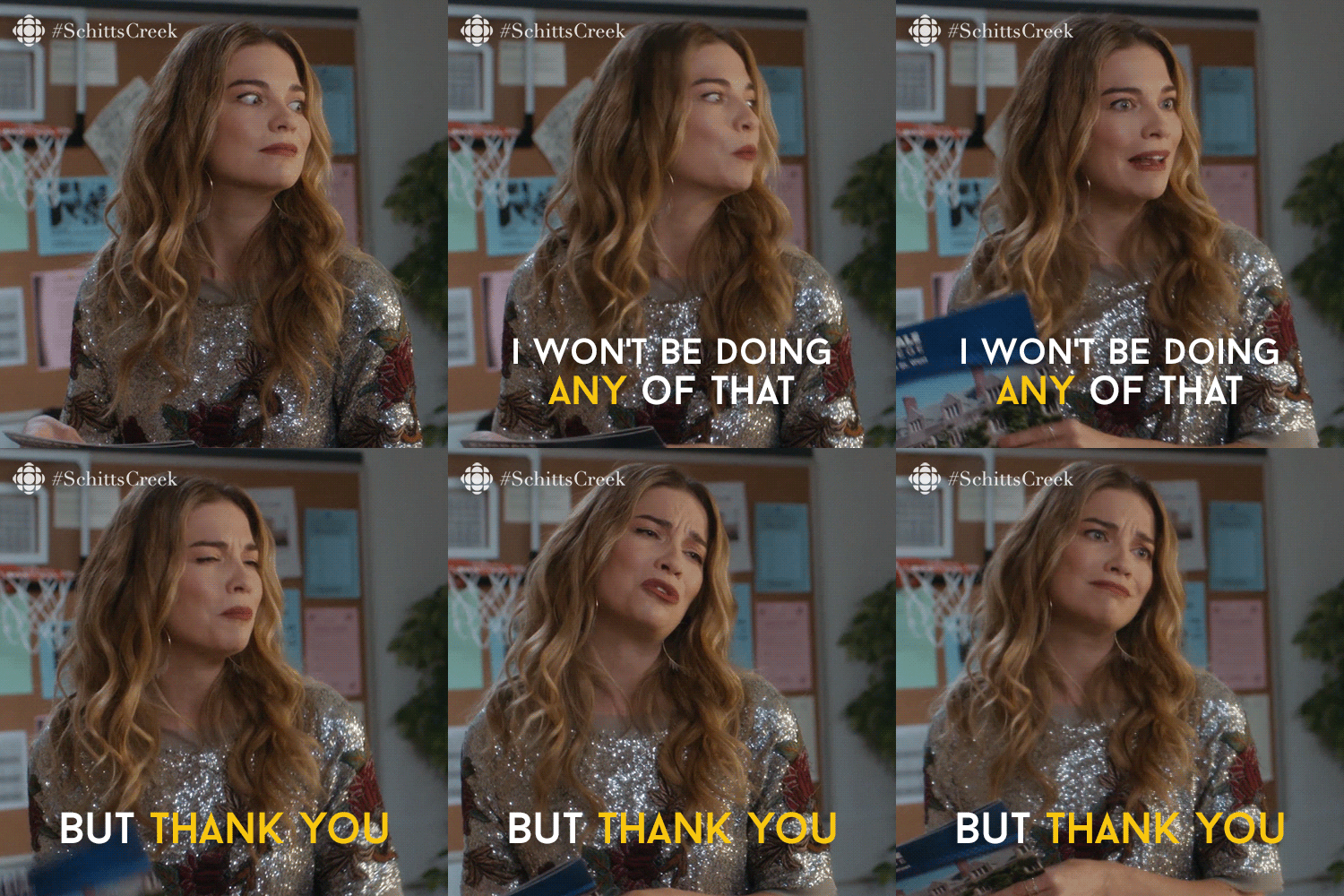
- StoryGraph lets you organise your reads by theme and content, and assign half-star ratings, which is something I’ve noticed a lot of people griping about. My personal rating system is ‘four stars means I enjoyed myself, five stars means I really enjoyed myself and the book will stay with me.’ Three stars or fewer and I’m not putting out bad energy by leaving a rating, because one person’s mediocre time-filler is another person’s favourite book ever written and I dunno if adding to negativity on the internet is really how I want to spend my time. I’d love to say ‘you do you’ if you’re a this-book-is-terrible-here’s-an-essay-on-why reviewer, but actually I’ve given it a lot of thought and I don’t get it.
More on bad reviews later, let’s chat Pagebound.
Reasons I wanted to try Pagebound as well as GoodReads and StoryGraph:
- StoryGraph uses AI and Pagebound, very vocally, does not.
- Pagebound is colourful.
- Pagebound also seems to be run by people.
So far this year I’ve popped onto each platform about once a week to record the week’s reading. I don’t interact with other users on any of the platforms very often, but I’m taking into account the general ‘chattability’ of each platform as I mull over what I like about them. It hopefully doesn’t need to be said but I’ll say it anyway: what I don’t enjoy about a platform might be what really scratches an itch for you. As far as I understand, all three platforms rely on volunteer librarians to add and edit book listings, and regardless of platform feature or ownership we love librarians. Please take a moment to thank all librarians everywhere. All right. Let’s gooo!
Pros and Cons of GoodReads
| Pros | Cons |
| -Decent search feature for different editions (presumably because it’s so old it’s got more material). -Easy to keep track of my ‘to read’ list for when I’m thinking about what to read next. -My favourite authors share their recommendations there. | -Clunky. -Looks like a site last updated in 2003, which is quite something given it launched in 2006. -Owned by Amazon. -A lot of reviewers on there seem to have the reading comprehension of an eight year old. ‘This book is bad because I didn’t like it’ followed by eight paragraphs of why anyone who does like it is an idiot. This is why I don’t tend to interact on there often. |
So far, then, not my fave. It is relatively easy to interact with posts in your feed, but searching for users by and finding your friends on there is a faff; you really need a person’s profile URL to click on to ‘friend’ them.
Pros and Cons of StoryGraph
| Pros | Cons |
| -Easy to see what I’ve been reading in terms of genre and themes, and which authors I return to. -Because it’s hard to read reviews, if people are sharing eight paragraphs on why a book is terrible and so is anyone who likes it… I can’t see it. I can happily record what I’ve read this week without seeing complaints about a book I loved. | -I’m sick of the AI-ification of my entire life. I don’t want a computer to recommend my next read based on data, I want a human who has read a book to recommend it because they thought it was interesting and I might too. -Thoughtful conversation about books can’t happen because there’s no comment feature. -You can’t find or read reviews easily on desktop. -The lack of reading comprehension in some of the reviews I do see puts it on par with GoodReads. |
According to the article I linked earlier, StoryGraph doesn’t allow comments on reviews as to discourage bad reviewer behaviour, which I respect, although I do wonder if the problems I hear reported about GoodReads (authors spamming competitors with bad reviews, fans or bots spamming each other’s reviews with comments) is less an issue with commenting features and more an issue with users having bad internet etiquette. The cutthroat nature of some publishing campaigns or the tribal nature of some fandoms may be more to blame for ‘review bombing’ than the comment feature itself.
Pros and Cons of Pagebound
| Pros | Cons |
| -You can add emojis to reviews and list on your profile the books that sum you up as a reader, which is fun. -It’s colourful. No muted beige or corporate business palette. The design might be a ploy to attract millennials who remember when the internet was colourful and a little bit cartoony… and it’s worked on this millennial!! (GoodReads presumably was never colourful.) -The tracking system lets you note when you pause or don’t finish a book so if you’re someone who cares about logging your reading, you can do so with specificity. -Clunky features are likely to be worked out because it’s still a new platform. -You hear from the co-founders and get the impression that an email regarding an issue would be responded to by a person. -There are forums for discussing books as opposed to just reviewing and rating them, so the space feels like more of a community than StoryGraph or GoodReads. -If you are interested in gamifying your reading with quests and badges (reading different or specific genres or authors as part of a challenge to read more, etc) then Pagebound will really appeal to you. | -Focus on ‘quests’ and ‘levelling up’ with points (earned from taking part in quests, which I think it the same as a readalong or a reading challenge), is not my thing. Traditional gamification of reading doesn’t interest me in itself because the act of reading books over doomscrolling is the game for me. -I don’t fully understand how the interface works yet. I think it’s originally an app and I’m using desktop, so a few features are a little bit hard to work out. |
Based on how pleasing it is to use, even with the odd faffy feature, Pagebound is my favourite so far (not least because the comments and conversations I have seen suggest a decent level of internet etiquette). In writing this post I’ve had a proper look at reading quests and may join one if there’s no time requirement, or if there’s no requirement to read all the books on the suggested list.
Goodreads’ main draw remains that my favourite authors are on there, and I like seeing their recommendations without having to go searching too far, but I’m not sure what else it has going for it other than its impressive catalogue.
StoryGraph feels impersonal, and not just because of the AI features. I don’t necessarily want to hold long and emotional conversations over a book tracking site, but I do enjoy seeing a bit of book commentary from the handful of people I’ve ‘friended’ and StoryGraph is just graphs. To be fair, GoodReads is good for commentary and personal recommendations if you follow or friend a decent run of people, although I suspect in the long run Pagebound might win in terms of friendliness.
It’s worth noting that everything I’m saying here is about my experience as a reader, not an author, but my experiences as an author probably do colour them. Navigating review and discovery sites as an indie author can be complicated and I usually regret browsing my own reviews. Is there a place for any type of authors on any review or discovery platform? I don’t know; I’m leaning towards probably not. I do know that I spent dozens of hours on my ARC campaign for Rotting Trees and did not enjoy having terrible reviews land at the top of my inbox right when I was trying to encourage people to give it a go. Even now I’ll look for a good quote to add to a piece of marketing and find my attention grabbed by a two star ‘thanks for the advanced copy! Here’s everything I hated!’ paragraph. That does not bring me the internal peace I seek in my daily life and, as I said, I’m bewildered by people’s need to shit on books they don’t like (especially if they were given a free copy to review and there was no moral or contractual requirement for them to even finish reading it). That is what I signed up for when I decided to self publish, though, so I can’t complain too much.
Depending on my workload, or desire to analyse digital reading trackers as an alternative to catastrophising world events, I will return to this topic throughout 2026. Maybe a mid-year and an end-of-year update? Let’s see which platforms I’m still using then!
By the way, I’m running a February giveaway: buy a copy of one of my physical books throughout Feb ’26 and I’ll send your giftee an ebook copy. Details here. Tell your friends to be nice in the reviews.
Let me know your favourite reading tracker in the comments and subscribe for more book posts!
Look after yourselves,
Francesca
Thanks for reading. If you’d like to read my short stories and see behind-the-scenes work, you can sample? the No. 1 Reader’s Club on Patreon for a month with this link. No pressure to stick around! Think of it as trying a miniature dessert with no requirement to eat the whole menu.
Here are the books I’ve published so far and where you can find them. If you enjoy my book recommendations, browse my Bookshop.org page here. Keep in touch via my monthly(ish) newsletter!


 Francesca's Thoughts
Leave a comment!